Susan L. Slager, PhD, discusses the use of polygenic risk scoring to assess individual risk for CLL.

Susan L. Slager, PhD, discusses the use of polygenic risk scoring to assess individual risk for CLL.

Sarah Sammons, MD, discusses some of the challenges seen with different regimens for HER2-positive metastatic breast cancer treatment

Reid Merryman, MD, discusses which patients are typically monitored for minimal residual disease and whether there are specific subtypes or stages where the assessment is particularly critical.
Domenica Lorusso, MD, PhD, discusses the rationale behind the phase 3 ENGOT-cx11/GOG-3047/KEYNOTE-A18 study.
Samer A. Al’Hadidi, MD, discusses factors influencing early use of chimeric antigen receptor T-cell therapy in patients with relapsed/refractory multiple myeloma.
Susan L. Slager, PhD, discusses the background of her research on inherited germline genetics for risk of chronic lymphocytic leukemia.
Oleg Gligich, MD, discusses utilizing circulating tumor DNA to assess patients with lung cancer.
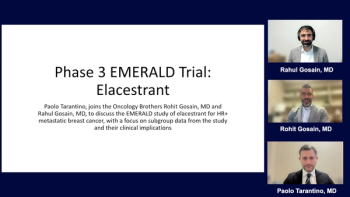
Along with the Oncology Brothers, Paolo Tarantino, MD, discusses ongoing studies investigating oral selective estrogen receptor degraders, including trials exploring use of elacestrant in combination with other therapies.
Along with the Oncology Brothers, Paolo Tarantino, MD, discusses what has been learned about the safety profile of elacestrant and shares clinical pearls for adverse event management, aimed at helping patients remain on therapy while maximizing their quality of life.
Along with the Oncology Brothers, Paolo Tarantino, MD, discusses the post -hoc subgroup analysis from the EMERALD study (SABCS 2023), which examined outcomes in patients with ESR1 mutations (ESR1m) who had been on CDK4/6 inhibitors (CDK4/6i) plus endocrine therapy for 12 months or longer, and shares her his perspectives on how these findings may influence the use of elacestrant in ER+/HER2–- metastatic breast cancer (MBC) and impact clinical practice for community oncologists.
Along with the Oncology Brothers, Paolo Tarantino, MD, elaborates on results from an analysis of data from the EMERALD study that were reported at the San Antonio Breast Cancer Symposium (SABCS) 2022. This analysis identified duration of prior CDK4/6 inhibitor therapy as a potential surrogate marker for endocrine sensitivity, and discusses how these findings could help guide patient selection for elacestrant.
Along with the Oncology Brothers, Paolo Tarantino, MD, discusses how ESR1 mutations are commonly observed in hormone receptor-positive breast cancer after prolonged endocrine therapy, and emphasizes the importance of molecular testing for ESR1 mutations at both the initial diagnosis of MBC and at each subsequent progression using liquid biopsy assays.
Along with the Oncology Brothers, Paolo Tarantino, MD, explores how ESR1 mutations frequently co-occur with other molecular alterations and the importance of maximizing endocrine-based therapy before moving on to antibody-drug conjugates or chemotherapy.

Joshua K. Sabari, MD, evaluates the objective clinical outcomes of emerging targeted therapies for ES-SCLC, comparing them with second-line topotecan and CAV regimens, while discussing the potential of various compounds for platinum-sensitive vs platinum-resistant subgroups. He also considers the applicability of TIGIT immunotherapy, highlighting the need for robust clinical trial data on its safety and efficacy as both monotherapy and in combination, and he reflects on whether tiragolumab is more suited for chemotherapy-naive non–small cell lung cancer than for ES-SCLC, based on the phase 2 CITYSCAPE trial results.
Joshua K. Sabari, MD, discusses the antitumor activity of second-line lurbinectedin, noting an ORR of 45%, a median DOR of 6.2 months, and a median OS of 11.2 months in patients with relapsed SCLC, and emphasizes the need for further studies to validate these findings in those with longer chemotherapy-free intervals while considering factors that may lead to lurbinectedin’s use over chemotherapy in candidates for platinum rechallenge, as well as the potential role of G-CSFs for prophylaxis.

Chunhui Han, PhD, discusses the potential feasibility of the integration of Gallium 68 PSMA-11 in biology-guided radiotherapy for patients with prostate cancer with bony metastases.

Antoni Vilaseca Cabo, MD, discusses the rationale behind the phase 1 study evaluating the safety and efficacy of TAR-210 in patients with FGFR-altered high- and intermediate-risk non–muscle invasive bladder cancer.

Petros Grivas, MD, PhD, elaborates on some key unanswered questions on approaches to bladder cancer treatment he discussed with participants at a Case-Based Roundtable event.
Joe DePinto, MBA, discusses some of the key challenges to equitable access to cell and gene therapies, especially in underserved populations.
Along with the Oncology Brothers, Paolo Tarantino, MD, provides an overview of the phase 3 EMERALD study that evaluated the efficacy of elacestrant as a second-line treatment for ER+, HER2- MBC, particularly in patients with tumors harboring an ESR1 mutation.
Panelist discusses how the future treatment landscape for EGFR-mutant advanced non–small cell lung cancer is evolving to address current unmet needs and offers clinical pearls to community oncologists for optimizing patient care in this rapidly changing field.

Evan Lipson, MD, discusses feedback he’s received from colleagues about responses in patients with melanoma.
Santhosh K. Sadashiv, MD, discusses the role of chimeric antigen receptor T-cell therapy in patients with multiple myeloma.
Harry Erba, MD, PhD, discusses the specific substudies included in myeloMATCH.
Erika P. Hamilton, MD, discusses antibody-drug conjugates in multiple types of breast cancer, and when to use these drugs in sequence.
Noah S. Kalman, MD, MBA, discusses how oncologists can determine the best course of action for the treatment and management of a patient with thyroid cancer.

Barbara O’Brien, MD, discusses the background behind the phase 2 TBCRC049 study investigating the combination of tucatinib, trastuzumab, and capecitabine for the treatment of patients with HER2-positive breast cancer and leptomeningeal metastasis.
Jaime Merchan, MD, discusses the background and findings from the LITESPARK-013 trial of belzutifan for the treatment of patients with advanced clear cell renal cell carcinoma.
Joshua K. Sabari, MD, describes the mechanism of action of lurbinectedin as a synthetic alkaloid that binds to guanine residues in the minor groove of DNA, forming adducts that disrupt DNA repair mechanisms and promote apoptosis in cancer cells, noting that its action contrasts with traditional alkylating agents by specifically interfering with DNA-protein interactions and transcription processes.
Joshua K. Sabari, MD, evaluates the potential of ifinatamab deruxtecan in combination with atezolizumab, with or without platinum-based chemotherapy, as first-line induction or maintenance therapy in ES-SCLC, emphasizing that statistically significant end points such as improved PFS and OS would be essential for clinical application in this patient population.