Elizabeth Logers, MD, PhD, discusses the implications of ovarian toxicity on female patients of reproductive age being treated with nirogacestat for desmoid tumors.

Elizabeth Logers, MD, PhD, discusses the implications of ovarian toxicity on female patients of reproductive age being treated with nirogacestat for desmoid tumors.

Andrea Roman, PharmD, BCOP, discusses findings from a study investigating the benefits of remote oncology pharmacists.
Vitaly Margulis, MD, discusses the key takeaways and next steps of the Apa-RP study of apalutamide plus androgen deprivation therapy in patients with high-risk localized prostate cancer.
Vitaly Margulis, MD, reflects on the secondary end points findings and safety data from the Apa-RP study in high-risk localized prostate cancer.
A key opinion leader addresses the persistent challenges and unmet needs in the management of advanced urothelial carcinoma, while offering their insight into the future direction and potential advancements within this rapidly evolving field of oncology.
A leading medical authority shares their hands-on experience with sacituzumab govitecan, focusing on the primary toxicity concerns, such as diarrhea and neutropenia, and outlining effective management strategies to mitigate these adverse effects and optimize patient care.
A key opinion leader delves into the intricacies of second-line and third-line treatment sequencing for patients with progressive disease, addressing the appropriate timing for repeat testing and elaborating on the critical factors that inform their personalized treatment approach.
A medical professional outlines their preferred first-line treatment strategy for managing patients diagnosed with metastatic urothelial carcinoma, providing valuable insights into their clinical decision-making process.
A leading expert in the field shares their insights on the specific biomarkers they evaluate, such as Trop2, FGFR, and PD-L1, and the optimal timing for conducting these tests based on their clinical experience and patient management strategies.
A key opinion leader offers a comprehensive overview of the present landscape of molecular testing in metastatic urothelial cancer, elaborating on how advancements in molecular testing have shaped his clinical practice and expressing optimism for their future incorporation into the National Comprehensive Cancer Network (NCCN) guidelines.
A urology expert elucidates the collaborative relationship between medical oncology and urology in terms of diagnostic testing, treatment strategies, and patient referrals, while underscoring the crucial role of a multidisciplinary approach in maximizing positive patient outcomes.
A key opinion leader presents a case study of a 73-year-old male patient diagnosed with metastatic urothelial carcinoma, highlighting the associated risk factors and challenges in establishing an accurate diagnosis.
Breast cancer specialists review key efficacy and safety data from the DESTINY-Breast04 trial investigating trastuzumab deruxtecan in patients with HR+/HER2-low metastatic breast cancer.
Aditya Bardia, MD, MPH, FASCO, and Laura Huppert, MD, discuss treatment sequencing practices and ongoing challenges in patients with HR+/HER2-low breast cancer.

Toni Choueiri, MD, and the Oncology Brothers discuss the PSMAfore study evaluating health-related quality of life and pain in taxane-naïve patients with metastatic castration-resistant prostate cancer.
Medical oncologists discuss how real-world evidence from the IMDC is informing treatment decisions in GU cancer.
Focusing on renal cell carcinoma, the Oncology Brothers and Toni Choueiri, MD, discuss KIM-1, a biomarker analysis in IMmotion010.
Toni Choueiri, MD, and the Oncology Brothers discuss the role of circulating tumor DNA in treatment paradigms for patients with genitourinary cancers.
Following ASCO 2024, Toni Choueiri, MD, joins the Oncology Brothers, Rahul Gosain, MD, and Rohit Gosain, MD, to discuss recent updates from the EV-302 study investigating enfortumab vedotin plus pembrolizumab in metastatic urothelial carcinoma.
Christopher Moertel, MD, discusses mirdametinib's mechanism of action and the implications of the phase 2b ReNeu trial of the agent in NF1-associated plexiform neurofibroma.
Michael Serzan, MD, discusses what a community oncologist should know about the phase 2 ARCITECT trial for patients with clear cell renal cell carcinoma.
Vitaly Margulis, MD, discusses the significance of a 100% biochemical recurrence-free rate at 2 years, and what this means for patients with high-risk localized prostate cancer.
Vitaly Margulis, MD, discusses the Apa-RP study of adjuvant treatment consisting of apalutamide and androgen deprivation therapy in patients with high-risk localized prostate cancer.
Jay Spiegel, MD, discusses what led to the initiation of a phase 2 study evaluating CRG-022 in patients with relapsed/refractory large B-cell lymphoma following treatment with CD19-directed CAR T-cell therapy.
Bradley McGregor, MD, discusses how ongoing trials hold the key for further breakthroughs in genitourinary cancer treatment.
Paolo Ghia, MD, PhD, discusses safety and efficacy findings from a 5-year update of the phase 2 CAPTIVATE trial for chronic lymphocytic leukemia and/or small lymphocytic lymphoma treatment.
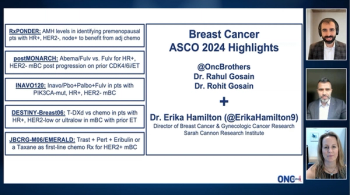
Focusing on HER2+ breast cancer, Erika P. Hamilton, MD, and the Oncology Brothers review data from JBCRG-M06/EMERALD looking at trastuzumab and pertuzumab in combination with eribulin or a taxane in locally advanced or metastatic disease.
Erika P. Hamilton, MD, and the Oncology Brothers review exciting data from DESTINY-Breast06 and discuss its impact on the evolving treatment landscape.
Medical oncologists discuss the INAVO120 study, which is evaluating inavolisib combination therapy in patients with PIK3CA-mutated breast cancer.
The Oncology Brothers and Erika P. Hamilton, MD, discuss the postMONARCH study investigating fulvestrant alone vs fulvestrant plus abemaciclib.