An expert on non–clear cell renal cell carcinoma provides clinical insights on TKI dosing strategies and duration of therapy implications for IO-TKI combinations.

An expert on non–clear cell renal cell carcinoma provides clinical insights on TKI dosing strategies and duration of therapy implications for IO-TKI combinations.
Following the 2024 ASCO Annual Meeting, Martin H. Voss, MD, discusses long-term follow-up data from the phase 2 KEYNOTE-B61 trial investigating pembrolizumab plus lenvatinib in the first-line treatment of advanced non–clear cell RCC.
Paolo Ghia, MD, PhD, discusses the key takeaways from 5-year data follow-up data from the phase 2 CAPTIVATE trial of ibrutinib plus venetoclax for the treatment of patients with chronic lymphocytic leukemia and/or small lymphocytic lymphoma.

Hematologic oncologists review therapeutic options for patients with chronic GVHD and provide clinical insights on their treatment approaches.
Corey Cutler, MD, MPH, and Hannah Choe, MD, provide an overview of chronic graft-vs-host disease (GVHD) and identify characteristics that differentiate it from acute GVHD.
Chris Benton, MD, provides an overview of first-line treatment options for patients with lower-risk myelodysplastic syndromes (LR-MDS).
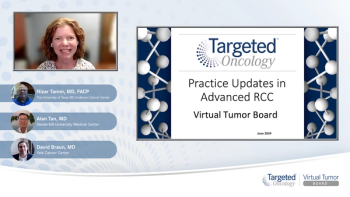
Dr Katy Beckermann introduces the panel of experts and addresses the first clinical case in this series, highlighting intermediate-risk, metastatic clear cell renal cell carcinoma.
Laura Huppert, MD, and Aditya Bardia, MD, MPH, FASCO, share advice for community oncologists on the utilization of T-DXd and discuss the future outlook for antibody-drug conjugates in HR+/HER2-low breast cancer.
Experts on breast cancer describe the best candidates for HER2-directed antibody-drug conjugates in HR+/HER2-low metastatic breast cancer, highlighting the role of trastuzumab deruxtecan in later lines of therapy.

Guillermo Garcia-Manero, MD, provides a brief overview of lower-risk myelodysplastic syndromes (LR-MDS).
The key opinion leaders explore extended follow-up results from the CheckMate-214 clinical trial.
Matthew Campbell, MD, MS, and Rana McKay, MD, offer a concise review of existing treatment approaches for clear cell renal cell carcinoma across risk categories, along with considerations for sequencing therapies.

Ali Duffens, MD, discusses a study in which investigators assessed the mode of detection for breast cancer recurrence within an integrated health system by assessing the utility and outcomes of current surveillance guidelines recommended by the National Comprehensive Cancer Network.
Missak Haigentz, MD, discusses the impact of the results from the ADRIATIC study of durvalumab as consolidation treatment after concurrent chemoradiation for the treatment of patients with limited-stage small cell lung cancer.

Mark A. Lewis, MD, discusses recent data from the COMMIT trial investigating first-line treatment of patients with deficient DNA mismatch repair or microsatellite instability–high metastatic colorectal cancer.
The Oncology Brothers and Mark A. Lewis, MD, review recent updates from the COLLISION study that were presented at the 2024 ASCO Annual Meeting.
Medical oncologists review recent data from the TRANSMET study evaluating chemotherapy plus liver transplantation in patients with unresectable colorectal liver metastases.
Mark A. Lewis, MD, and the Oncology Brothers discuss recent updates from the ARMANI trial in HER2- gastric/ gastroesophageal junction cancer.
Following ASCO 2024, Mark A. Lewis, MD, joins Rahul Gosain, MD, and Rohit Gosain, MD, to provide comprehensive insights on recent updates from the ESOPEC trial in esophageal adenocarcinoma.
Sham Mailankody, MBBS, looks to the future treatment landscape for early relapsed/refractory multiple myeloma and addresses ways to improve patient access to care.
A medical oncologist discusses the significance of recent data and CAR T-cell therapy approvals in early relapsed/refractory multiple myeloma.
An expert on multiple myeloma provides a comprehensive overview of adverse events associated with CAR T-cell therapy and highlights strategies to monitor and manage AEs effectively.
Sham Mailankody, MBBS, summarizes recent data from the KarMMa-3 trial investigating ide-cel in patients with early relapsed/refractory multiple myeloma.
A myeloma specialist reviews the latest efficacy outcomes from the CARTITUDE-4 trial evaluating cilta-cel in patients with relapsed/refractory multiple and discusses how the results are informing treatment decisions.
Sham Mailankody, MBBS, provides an overview of challenges associated with CAR T-cell therapy in relapsed/refractory multiple myeloma, including location and financial considerations.
A medical oncologist discusses the referral process for patients being considered for CAR T-cell therapy in early relapsed/refractory multiple myeloma, highlighting factors that inform treatment selection.
An expert on multiple myeloma outlines key considerations for selecting early-line treatments for high-risk patients with relapsed/refractory multiple myeloma.
Sham Mailankody, MBBS, presents the case of a 70-year-old man with early relapse multiple myeloma and outlines clinical practices for identifying patients with high risk.
A genitourinary oncologist discusses current treatment options available for patients with non–clear cell renal cell carcinoma and discusses the roles of tyrosine kinase inhibitors (TKIs), PD-1 inhibition, and combination therapy.
Martin H. Voss, MD, provides an overview of advanced non–clear cell renal cell carcinoma (nccRCC), highlighting epidemiology and pathological classification.