
Doris Hansen, MD, discusses the efficacy of daratumumab, lenalidomide, and dexamethasone vs bortezomib, lenalidomide, and dexamethasone in newly diagnosed myeloma.

Doris Hansen, MD, discusses the efficacy of daratumumab, lenalidomide, and dexamethasone vs bortezomib, lenalidomide, and dexamethasone in newly diagnosed myeloma.
Jose Lutzky, MD, discusses clinical trials investigating novel therapies for melanoma.

Lori J. Wirth, MD, discusses some of the emerging trends and developments that are on the horizon in the thyroid cancer space.
Saad Z. Usmani, MD, MBA, FACP, FASCO, discusses the specific patient subgroups for whom autologous transplant remains the best course of action for.
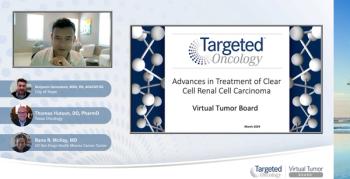
The expert panel concludes with insights on the treatment of patients with renal cell carcinoma who progress following adjuvant therapy.
Jose Lutzky, MD, discusses the innovative tumor-inflitrating lymphocyte therapy for the treatment of relapsed or refractory melanoma.

Rahul Banerjee, MD, FACP, physician-researcher at Fred Hutch Cancer Center in Seattle, WA, discusses the potential links between CAR T-cell therapy and secondary T-cell malignancies.
Targeted Oncology spoke with Howard D. Edington, MD, about how experts are addressing the potential of resistance challenges with oncolytic viruses as part of its Speaking Out video series.

Prithviraj Bose, MD, introduces study designs for trials focusing on JAK inhibitor utilization in patients receiving treatment for myelofibrosis.
Medical experts discuss strategies to navigate a complex patient scenario pertaining to previous refusal of ASCT.
Kim N. Chi, MD, FRCPC, discusses how the findings from the phase 3 MAGNITUDE trial translate into everyday practice.
Gabriel N. Hortabagyi, MD, FACP, provides an overview of the phase 3 NATALEE trial evaluating the combination of ribociclib with endocrine therapy as adjuvant treatment in patients with hormone receptor-positive/HER2-negative early breast cancer.

Antoni Vilaseca Cabo, MD, discusses phase 1 data presented on TAR-210 for the treatment of patients with FGFR-altered high- and intermediate-risk non-muscle invasive bladder cancer.
Experts on renal cell carcinoma discuss how clinical trial data inform treatment decisions, highlighting the negative results from PROSPER, CheckMate 914 Part A, and IMmotion010.
Dr Pal discusses the study design and results of the KEYNOTE-564 trial, and Benjamin Gerendash, MSN, RN, AGACNP-BC, discusses the management of adverse events associated with pembrolizumab.
Binod Dhakal, MD, MS, discusses the basis of the FDA approval of ciltacabtagene autoleucel for relapsed/refractory multiple myeloma that has been treated with at least 1 prior line of therapy and is refractory to lenalidomide.

Nazli Dizman, MD, discusses her research on adherence to the American Society of Clinical Oncology Language of Respect Guidelines among patients with renal cell carcinoma.

Halle Moore, MD, discusses some of the main concerns that patients with breast cancer have about fertility after treatment.
Lori J. Wirth, MD, discusses the role of lenvatinib following its approval from the FDA for the treatment of patients with radioactive iodine-refractory differentiated thyroid cancer.
Targeted Oncology spoke with Howard D. Edington, MD, about the advancements in engineering oncolytic viruses to be able to target specific cancers and various combination therapies with the novel treatment.

In this concluding segment, Dr. Shore will share clinical pearls and practical insights regarding the optimal management of patients with metastatic hormone-sensitive prostate cancer.
Dr. Shore will highlight the importance of a multidisciplinary approach in the management of patients with mHSPC and the roles of various healthcare professionals in providing comprehensive care.
Dr. Shore will discuss the factors that guide treatment choices for mHSPC patients with a high disease burden and comorbidities.
In this segment, Dr. Shore will review the findings of several pivotal Phase 3 trials evaluating the efficacy of various treatments in metastatic hormone-sensitive prostate cancer patients, including the MAGNITUDE, PROpel, and TALAPRO-2 trials, among others.
Dr. Shore will provide an overview of the Phase 3 ARASENS trial, which evaluated the efficacy of the androgen receptor inhibitor darolutamide in combination with androgen deprivation therapy (ADT) and docetaxel in hormone-sensitive prostate cancer patients. He will discuss the potential benefits of this combination in patients with high tumor burden mHSPC.
Dr. Shore will explore the evidence supporting treatment intensification through combining or sequencing therapies in metastatic prostate cancer. He will discuss the potential benefits and downsides of this approach, as well as which patients may benefit from an intensified treatment strategy.
Key findings from COMFORT I and COMFORT II studies are examined.
Expert panelists highlight the COMFORT I and COMFORT II studies.
In this segment, Dr. Shore will offer an overview of current treatment options for metastatic hormone-sensitive prostate cancer (mHSPC), as outlined in the NCCN Guidelines for Prostate Cancer. He will discuss patient factors that guide the selection of therapeutic agents or combination therapies.