
Douglas W. Sborov, MD, MS, provides a summary of the key details of the 54-year-old patient's medical history and multiple myeloma diagnosis.

Douglas W. Sborov, MD, MS, provides a summary of the key details of the 54-year-old patient's medical history and multiple myeloma diagnosis.

Other considerations between KRAS targeting treatments in patients with KRAS+ mutated NSCLC.
An overview of recognizing and managing common immune-related and systemic adverse events with immune checkpoint inhibitors, chemotherapy and KRAS targeted therapies in NSCLC.
Clinical trial efficacy and safety data between KRAS G12C inhibitors that inform initial treatment selection for patients with NSCLC.
An overview of the role of KRAS G12C inhibitors in the second line and beyond for KRAS G12C mutated NSCLCs after progression on platinum-based chemotherapy.
Cinical trial data and guidelines on optimal first-line regimens for metastatic KRAS mutated lung adenocarcinoma.

Mazyar Shadman, MD, MPH, explains the current standard-of-care treatment for patients with chronic lymphocytic leukemia and details the factors he considers when choosing an appropriate therapy.
Background on KRAS mutations in lung adenocarcinoma, including the prevalence, prognosis, and challenges in treating patients with NSCLC.
Lori Wirth, MD, discusses second-line treatment in relation to the patient case, and concludes the discussion with a look at emerging treatment options and the future of treating advanced RAI-refractory DTC.
An expert on thyroid cancer provides insights on treating patients with advanced RAI-refractory DTC who harbor BRAFV600E mutations.

Dr Garica-Manero provides a brief overview of the current treatment paradigm for lower-risk MDS as well as discussing some unmet needs.
Lori Wirth, MD, discusses molecular testing practices for patients with advanced RAI-refractory differentiated thyroid cancer.
Sandip P. Patel, MD, offers advice to fellow oncologists and highlights unmet needs and future directions in the treatment of patients with non–small cell lung cancer.
A medical oncologist reviews real-world data on older patients with RAI-refractory DTC and provides her thoughts on treating this patient population.
An overview of the standard of care treatment for patients with advanced radioiodine-refractory differentiated thyroid cancer.
A medical oncologist reviews the efficacy and safety outcomes from the ADAURA trial investigating osimertinib in resected EGFR-mutated NSCLC and discusses how biomarkers inform treatment selection.
Lori Wirth, MD, discusses the safety profiles of sorafenib and lenvatinib and provides clinical insights on managing or mitigating adverse effects.
Turning the focus to EGFR inhibitors, Sandip P. Patel, MD, discusses their mechanism action and the improved toxicity profile of next-generation inhibitors.
A medical oncologist provides a comprehensive overview of the current treatment options for patients with advanced RAI-refractory DTC and reviews clinical trial data on sorafenib and lenvatinib.
Expert perspectives on treating patients with non–small cell lung cancer, with a focus on treatment goals and patient factors that inform clinical decision-making and sequencing considerations.
A leading expert on head and neck oncology provides her initial impressions on the case of a 64-year-old woman with differentiated thyroid cancer.
A medical oncologist offers his initial impressions of the patient profile of a 60-year-old with early-stage NSCLC and discusses biomarker testing practices, highlighting types of testing and challenges.
Experts review best practices for identifying and diagnosing patients with lower-risk MDS.
Lori Wirth, MD, a medical oncologist, reviews the case of a 64-year-old woman with differentiated thyroid cancer (DTC).
Sandip P. Patel, MD, reviews the case of a 60-year-old woman with early-stage non–small cell lung cancer (NSCLC).

Patrick Forde, MBBCh, discusses the results of the TRIDENT-1 trial that led to the approval of repotrectinib for patients with metastatic ROS1 positive NSCLC.

Paula Rodriguez-Otero, MD, PhD, discusses the promising results from the phase 3 PERSEUS trial in patients with newly diagnosed, transplant-eligible multiple myeloma.
Adrian Cristian, MD, discusses the background of the third annual Miami Cancer Institute Oncology Rehabilitation Symposium and provides an overview of some of the topics that were presented this year.
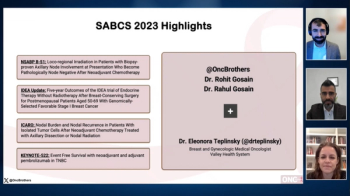
Following their review of clinical trial data presented at SABCS 2023, the Oncology Brothers offer their key takeaways on recent updates in breast cancer.
Medical oncologists discuss recent data from KEYNOTE-522 looking at event-free survival with neoadjuvant and adjuvant pembrolizumab in triple-negative breast cancer.