

BREAST CANCER
Latest News
Advertisement
Latest Videos
































Advertisement
More News

Promising clinical trial results have been seen with the exploration of new and existing treatment approaches for patients with triple-negative breast cancer (TNBC) on several fronts, including chemotherapy, immunotherapy, novel antibodies, and agents targeting the PI3K/mTOR/AKT pathway, according to David W. Miles, MB BS, BSc, MD. During a presentation at the <em>1st Annual </em>Paris Breast Cancer Conference hosted by the Physicians Education Resource®, LLC, Miles, a consultant medical oncologist at West Hertfordshire Hospitals in England, provided his perspective on potential new treatment options for patients with TNBC.
Eli Lilly and Company has announced that Kimberly L. Blackwell, MD, a pioneer in breast cancer research, will serve as its vice president of early phase development and immuno-oncology. She will begin her new role on March 12, 2018.<br />
Lori Goldstein, MD, FASCO, is among 27 breast oncologists across the country to be recognized by <em>Forbes’ </em>“Physician Honor Role”<em> </em>as an extraordinary physician in the field of oncology.
Treatment with ladiratuzumab vedotin demonstrated an estimated median progression-free survival (PFS) of 11.6 weeks for patients with heavily pretreated metastatic triple-negative breast cancer (TNBC) treated with the recommended phase II dose of the antibody–drug conjugate, according to results of a phase I study presented during the 2017 San Antonio Breast Cancer Symposium.
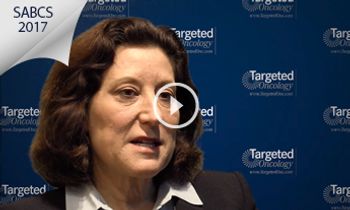
Hope S. Rugo, MD, professor of medicine and director of the Breast Oncology Clinical Trials Program at the UCSF Helen Diller Family Comprehensive Cancer Center, discusses the 5-year follow-up of the CALGB 40502 study for patients with triple-negative breast cancer (TNBC).
Treatment discontinuation due to toxicity was less frequent with olaparib (Lynparza) monotherapy compared with chemotherapy in patients with HER2-negative metastatic breast cancer and a germline <em>BRCA</em> mutation in the phase III OlympiAD study.
GeparSepto Trial Demonstrates Improved Survival in High-Risk Early Breast Cancer With Nab-Paclitaxel
In findings from the phase III GeparSepto trial presented during the 2017 San Antonio Breast Cancer Symposium, long-term disease-free survival rates were improved with neoadjuvant nab-paclitaxel (Abraxane) compared with standard paclitaxel in patients with high-risk early breast cancer.
Survival rates improved with nab-paclitaxel (Abraxane) therapy compared with paclitaxel in patients with triple-negative breast cancer (TNBC) more than in other patient subsets, according to findings from a post-hoc analysis from the CALGB 40502/NCCTG N063H clinical trial.
Results of a prospective clinical trial demonstrated that the detection of positive circulating tumor cells in the blood 5 years after hormone receptor-positive, HER2-negative breast cancer diagnosis was associated with an increased risk for late recurrence.

Tari King, MD, chief of Breast Surgery, Dana-Farber/Brigham and Women's Cancer Center, discusses a "less is more" approach when it comes to lymph node surgery in patients with breast cancer.
Treatment with a gonadotropin-releasing hormone analog could potentially preserve fertility and protect ovarian function in premenopausal woman being treated with chemotherapy for early-stage breast cancer, according to the results of a meta-analysis presented at the 2017 San Antonio Breast Cancer Symposium.
Results of the phase III SOLD trial maintained the benefit of 12 months of adjuvant treatment with trastuzumab (Herceptin) for patients with early stage HER2-positive breast cancer, as the trial failed to demonstrate noninferiority for 9 weeks of trastuzumab versus the standard 1-year period, when added to chemotherapy.
Disease-free survival is maintained in women with postmenopausal hormone receptor-positive breast cancer treated with aromatase inhibitors, even when the treatment is only given for 2 years in comparison with the standard 5 years of additional aromatase inhibitor therapy, according to findings from the phase III ABCSG-16 trial presented at the 2017 San Antonio Breast Cancer Symposium.

Denise Yardley, MD, senior investigator, Sarah Cannon Research Institute, discusses the results from a recent phase II trial evaluating exemestane with or without enzalutamide in patients with hormone receptor–positive breast cancer.

Julie Nangia, MD, assistant professor of Medicine, Baylor College of Medicine, discusses getting genetic testing for patients. While the NCCN has guidelines of who should be tested, it may also be possible for physicians to write a letter of medical necessity for other people, such as Ashkenazi Jewish women, who have higher rates of BRCA mutations.
Early-stage breast cancer recurrence and mortality was reduced by shortening the intervals between chemotherapy cycles or administering the drugs sequentially compared with standard dosing techniques, according to meta-analysis results presented at the 2017 San Antonio Breast Cancer Symposium.

Mothaffar F. Rimawi, MD, associate professor and director of clinical research at the Lester and Sue Smith Breast Center at Baylor College of Medicine, discusses the NSABP B-47 study, which explored the value of trastuzumab (Herceptin) plus standard adjuvant chemotherapy in breast cancer patients with low levels of HER2 protein.
An overall disease control rate of 45% was achieved with sacituzumab govitecan (IMMU-132) therapy in patients with heavily pretreated metastatic triple-negative breast cancer (mTNBC), according to updated findings of a study presented at the 2017 San Antonio Breast Cancer Symposium (SABCS).
In results from the phase Ib/II PANACEA trial presented at the 2017 San Antonio Breast Cancer Symposium (SABCS), the combination of pembrolizumab (Keytruda) and trastuzumab (Herceptin) achieved an objective response rate (ORR) of 15.2% in patients with trastuzumab-resistant, PD-L1–positive, HER2-positive breast cancer.
Sir Richard Peto, FRS, a recognized pioneer in epidemiology and health statisticians, will be honored with the William L. McGuire Memorial Lecture Award at the 2017 San Antonio Breast Cancer Symposium (SABCS), to be held December 5 to 9 in San Antonio, Texas. The topic of his award lecture will be announced at a later date, according to a press release from SABCS.
Renowned scientist Ramon Parsons, MD, PhD, has been awarded an Outstanding Investigator Award (OIA) from the National Cancer Institute. The award guarantees $6.7 million for 7 years of research into the tumor-suppressing functions of the <em>PTEN</em> gene, which he discovered.
Laura J. van’t Veer, PhD, discusses determining more accurate methods of treatment for patients with early- and late-stage breast cancer based on advances in genetic testing, specifically the 70-gene prognostic signature.
Lajos Pusztai, MD, discusses neoadjuvant and adjuvant treatment decisions for patients with HER2-positive breast cancer, as well as the potential of immunotherapy in the metastatic setting.<br />
Adam M. Brufsky, MD, PhD, professor of Medicine, associate chief of Hematology/Oncology, co-director of the Comprehensive Breast Care Center, associate director of Clinical Investigation, University of Pittsburgh, discusses ovarian suppression and bone cancer management in breast cancer.
Advertisement
Advertisement
Trending on Targeted Oncology - Immunotherapy, Biomarkers, and Cancer Pathways
1
FDA Accepts NDA for Daraxonrasib in Metastatic Pancreatic Cancer
2
Advanced Renal Cell Carcinoma: Tailoring Second-Line Therapy After Prior Immunotherapy
3
Teclistamab/Talquetamab Reduces Risk of Progression by 89% in R/R Multiple Myeloma
4
IMNN-001 Plus Chemo Cuts MRD Rate in Frontline Ovarian Cancer
5