


EGFR+ Lung Cancer
Latest News
Advertisement
Latest Videos















































Advertisement
More News

Mesothelin-targeted chimeric antigen receptor T-cell therapy has shown early evidence of efficacy in a phase I trial of patients with malignant pleural disease and mesothelioma, non–small cell lung cancer, or breast cancer. Additionally, significant responses were seen in patients who went on to receive subsequent PD-1 checkpoint inhibition treatment.

An accelerated approval has been granted by the FDA to single-agent nivolumab for the treatment of patients with small cell lung cancer with disease progression following a platinum-based chemotherapy and 1 other prior line of therapy.
Checkpoint inhibitors are revolutionizing the treatment of patients with both squamous and nonsquamous non-small cell lung cancer, and are quickly assuming a predominant role, especially in the frontline setting, due to recent exciting results from large trials.<br />
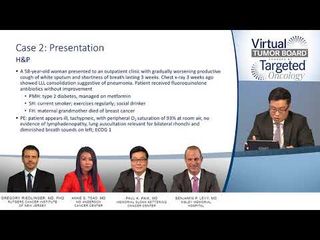
Kartik Konduri, MD, recently spoke on the treatment considerations and decisions he makes when treating patients with non–small cell lung cancer. Konduri, medical director of the Chest Cancer Research and Treatment Center, Baylor University Medical Center, explained his treatment decisions based on 2 case scenarios during a <em>Targeted Oncology</em> live case-based peer perspectives presentation.
Joshua Bauml, MD, speaks on the treatment options and considerations he makes when treating patients with non–small cell lung cancer. Bauml explained his treatment decisions based on 2 case scenarios during a <em>Targeted Oncology </em>live case-based peer perspectives presentation.
Hossein Borghaei, DO, MS, discusses results from the subgroup analysis of the ongoing CheckMate-227 trial investigating the combination of nivolumab and ipilimumab in metastatic NSCLC.
Lurbinectedin (PM1183) has been granted orphan drug designation from the FDA for the treatment of patients with small cell lung cancer, according to PharmaMar, the manufacturer of the marine-derived treatment.
The Gene Upshaw Memorial Tahoe Forest Cancer Center has established a cancer care model to address disparities in lung cancer in rural areas. By partnering with the UC Davis Comprehensive Cancer Center and their UC Davis Cancer Care Network, they have been able to address a large issue in cancer care, where 20% of the American population is living in a rural area without access to a National Cancer Institute-designated cancer center.
The FDA issued several approvals in July, including in colorectal cancer, breast cancer, prostate cancer, and acute myeloid leukemia. Here’s a look back on the FDA happenings for the month of July 2018.
Roy S. Herbst, MD, PhD, Yale Cancer Center, discusses the use of combination immunotherapy for the treatment of lung cancer.
The approval of pembrolizumab has been recommended by the European Medicines Agency’s Committee for Medicinal Products for Human Use as a frontline treatment for patients with metastatic nonsquamous non–small cell lung cancer without <em>EGFR</em> or <em>ALK</em> mutations, regardless of PD-L1 expression. The recommendation is based on data from the phase III KEYNOTE-189 trial.
According to Tony S. Mok, MD, first-line treatment with tyrosine kinase inhibitors for patients with non–small cell lung cancers harboring uncommon driver mutations can be controversial. Instead, there is more evidence supporting the use of TKIs in the second-line for mutations such as <em>ROS1 </em>and <em>BRAF</em>, he explained during a presentation at the <em>19th Annual </em>International Lung Cancer Congress.<br />
In a presentation at the <em>19th Annual</em> International Lung Cancer Congress, Tetsuya Mitsudomi, MD, PhD, provided sequencing options to utilize the many available regimens for the best potential survival outcomes for patients with <em>EGFR</em>-mutant non–small cell lung cancer.
Laurence J. Heifetz, MD, FACP, medical director, Gene Upshaw Memorial Tahoe Forest Cancer Center, discusses a novel approach to managing disparities in lung cancer care.
The use of checkpoint inhibition in patients with locally advanced non–small cell lung cancer in combination with chemoradiation, and specifically durvalumab from the PACIFIC trial, has shown the first significant survival benefits in almost 25 years, according to Corey J. Langer, MD.
Combinations with immunotherapy agents have surged ahead with new regimens showing great potential for the treatment of patients with lung cancer, Corey Langer, MD, said during a presentation at the <em>19th Annual </em>International Lung Cancer Congress (ILCC). Knowledge about a growing number of biomarkers are helping to guide treatment decisions with these combination options, he said, but the one standard of care has not yet been determined.

Ignacio I. Wistuba, MD, Department of Translational Molecular Pathology, Division of Pathology and Laboratory Medicine, The University of Texas MD Anderson Cancer Center, discusses how clinicians can best integrate molecular pathology into their treatment selection for patients with non-small cell lung cancer.
In an interview with <em>Targeted Oncology </em>at the 19<sup>th</sup>Annual International Lung Cancer Congress, Bunn, professor in the Division of Medical Oncology at the University of Colorado Cancer Center, discussed the potential approaches with neoadjuvant or adjuvant therapies for curing patients with lung cancer. He also shares his own opinions on which approaches might be best.

Giorgio Vittorio Scagliotti, MD, PhD, chief of the Medical Oncology Division at the S. Luigi Hospital, Orbassano (Torino), and head of the Department of Oncology at University of Torino, Italy, discusses the utilization of molecular profiling to inform treatment decisions for patients with non-small cell lung cancer.
In a keynote address by Frances A. Shepherd, MD, FRCPC, OOnt, OC, during the <em>19th Annual </em>International Lung Cancer Congress, Shepherd expressed that <em>EGFR-</em>mutant non–small cell lung cancer (NSCLC) is a model for how far the field of lung cancer has progressed in the past decade, thanks in large part to molecular pathologists.
Several biomarkers are beginning to emerge for immunotherapy in non–small cell lung cancer, and the collection of these markers, when used together, could further help to predict which patients are likely to respond to these therapies alone or in combination, according to a presentation by Giorgio Scagliotti, MD, PhD, at the <em>19th Annual</em> International Lung Cancer Congress.
Several novel agents are beginning to show promise for new targets in non–small cell lung cancer, especially <em>NRG1</em> and <em>LKB1, </em>and could be positioned to join already established standard-of-care therapies.
The primary endpoint of the phase III ALTA-1L trial has been met, as brigatinib was found to reduce the risk of disease progression or death versus crizotinib in adult patients with locally advanced or metastatic <em>ALK</em>-positive non–small cell lung cancer who had not received a prior ALK inhibitor, Takeda Pharmaceutical Company, the manufacturer of brigatinib, has announced.
According to findings from the phase III IMpower132 study, the addition of atezolizumab to pemetrexed and cisplatin or carboplatin reduced the risk of disease progression or death compared with chemotherapy alone in patients with advanced nonsquamous non–small cell lung cancer.
Alexander Drilon, MD, discusses the data currently available with targeting gene fusions, and shares insight into what is on the horizon in this area.
Advertisement
Advertisement
Trending on Targeted Oncology - Immunotherapy, Biomarkers, and Cancer Pathways
1
Denosumab Biosimilar Approved For Existing Oncology Indications
2
FDA Oncology Recap: Approvals, Designations, and Decisions in September 2026
3
Plinabulin Receives FDA Fast Track Designation in Post-ICI NSCLC
4
Tile-Based Radiation Improves Local Control in Resected Brain Metastases
5