The panelist discusses how, Healthcare professionals use osimertinib 1L for EGFR-mutated NSCLC, re-testing at progression for resistance mutations. MARIPOSA data refine 1L choices by predicting resistance pathways, guiding optimal sequencing.

The panelist discusses how, Healthcare professionals use osimertinib 1L for EGFR-mutated NSCLC, re-testing at progression for resistance mutations. MARIPOSA data refine 1L choices by predicting resistance pathways, guiding optimal sequencing.

Panelists discuss the efficacy and safety of KRAS inhibitors for non–-small cell lung cancer (NSCLC), evaluating clinical trial results and their potential impact on treatment strategies.
Panelists discuss second-line treatment decision-making for KRAS-mutated metastatic non–-small cell lung cancer (NSCLC), focusing on available therapies and personalized approaches based on patient characteristics.

Panelists discuss how treatment sequencing decisions in myelofibrosis should be guided by clinical evidence, patient response patterns, and strategic consideration of future therapeutic options to maintain long-term disease control.
Panelists discuss how the timing of therapeutic interventions in early-stage myelofibrosis must be carefully weighed against potential risks and benefits, with consideration of disease trajectory and patient-specific factors to optimize long-term outcomes.

Panelists discuss how CARTITUDE-4 demonstrated superior progression-free survival and overall response rates with ciltacabtagene autoleucel (cilta-cel) compared with standard treatment options in relapsed/refractory multiple myeloma (R/R MM) patients who received 1 to 3 prior lines of therapy.
Panelists discuss how to address practical challenges in delivering chimeric antigen receptor (CAR) T cell therapy, including patient selection, bridging therapy, manufacturing delays, access barriers, and coordination of care to optimize real-world outcomes.

An expert discusses the therapeutic options included in the NCCN guidelines for metastatic castration-resistant prostate cancer, such as abiraterone (ABI) based on COU-AA-301 and enzalutamide (ENZA) based on AFFIRM.

A panelist discusses how second-line treatment options for kidney cancer have evolved through multiple clinical trials including Study 205, METEOR, CONTACT-03, TIVO-3, TiNivo-2, and LITESPARK-005, which have demonstrated varying efficacy across different patient populations and prior therapies, particularly noting the impact of prior immunotherapy exposure on treatment selection and the need for careful consideration of historical trial data in the context of modern treatment paradigms.
An expert discusses the case of a patient with metastatic castration-resistant prostate cancer (CRPC) who progressed after treatment with androgen receptor pathway inhibitors (ARPI) and docetaxel for localized prostate cancer.
The panelist discusses how, Healthcare professionals manage distinct toxicities with ami+laz (IRRs, rash) and osi+chemotherapyctx (cytopenias, diarrhea, fatigue). SKIPPirr informs IRR mitigation in ami’s first infusion. Proactive AE strategies include premedication, dose adjustments, supportive care, and monitoring.
The panelist discusses how, regarding the patient case, she will review the FDA approved options for the patient, including the combination of amivantamab + Lazertinib, osimertinib/chemotherapy, or single agent osimertinib.
A panelist discusses how second-line therapy goals typically shift from pursuing complete remission (as in first-line treatment) to focusing more on disease control, quality of life management, and balancing treatment effectiveness with tolerability based on the patient's prior therapy experience.
Panelists discuss first-line treatment decision-making for KRAS-mutated metastatic non–-small cell lung cancer (NSCLC), focusing on the selection of targeted therapies and factors influencing clinical choices.
Panelists discuss the use of RNA-based molecular panels in metastatic non–-small cell lung cancer (NSCLC), highlighting their role in guiding personalized treatment decisions and improving patient outcomes.
Panelists discuss how complex cases of advanced myelofibrosis can be managed using evidence-based treatment algorithms, considering factors such as disease progression, prior therapies, and challenging complications.
Panelists discuss how clinicians can effectively manage patients with high-risk myelofibrosis with cytopenias through careful treatment selection, dose modification strategies, and monitoring of hematologic parameters.
Panelists discuss how to manage an aggressive case of early posttransplant progression in a young woman with functionally high-risk multiple myeloma (MM), focusing on rapid intervention strategies and novel therapeutic approaches to overcome poor prognosis disease.
Panelists discuss how to approach treatment selection and sequencing for a 58-year-old woman with high-risk multiple myeloma (MM) who has developed progressive disease after stem cell transplantation, considering factors such as prior therapy exposure, available options, and disease biology.
Panelists discuss decision-making in metastatic non–-small cell lung cancer (NSCLC) when molecular testing results are delayed, focusing on strategies to optimize treatment while awaiting results.
Panelists discuss the role of molecular testing in metastatic non–-small cell lung cancer (NSCLC), emphasizing its importance in identifying actionable mutations and guiding personalized treatment strategies.
The panelist discusses how, when discussing first-line treatment decisions for cancer patients, healthcare professionals primarily consider patient-specific factors like disease stage, molecular profile, comorbidities, and performance status. When discussing options with high-risk patients, healthcare professionals typically take a shared decision-making approach, thoroughly explaining both potential benefits and side effect management strategies. These conversations weigh factors like quality-of-life impact, monitoring requirements, and individual patient preferences to arrive at an optimal treatment strategy.
Panelists discuss how; the patient case presents a 47-Year-Old Woman with EGFR-mutated Advanced/Metastatic NSCLC. The patient presents to her primary care physician (PCP) with continued dry cough, dyspnea, and weight loss. She has a history of hypertension, previously managed on an ACE inhibitor, but is now on atenolol.
Panelists discuss how clinical trial data inform the selection of second-line therapies for patients with myelofibrosis, focusing on response assessment criteria and identifying optimal candidates for various treatment options.
Panelists discuss how myelofibrosis can evolve following initial treatment, examining common patterns of disease progression and strategies for adapting therapeutic approaches based on individual patient response and changing clinical parameters.
Panelists discuss how to optimize maintenance therapy following autologous stem cell transplantation by evaluating factors such as duration, drug selection, and risk-adapted approaches to maximize long-term outcomes in multiple myeloma patients.
Panelists discuss how the paradigm in transplant-eligible newly diagnosed multiple myeloma (NDMM) has shifted to considering which patients should not receive quadruplet CD38-containing regimens rather than who should, given the compelling efficacy data supporting this approach.
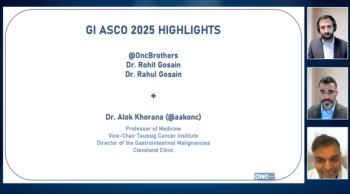
Experts discuss an overview of the STARTER-NET study, emphasizing its goals, key outcomes, and potential impact on clinical practice.
Experts discuss an overview of the ALASCCA study, highlighting its objectives, results, and clinical implications.
Experts discuss the CheckMate 8HW study, focusing on its design, key findings, and impact on treatment strategies.