scout

Videos

An expert discusses the treatment approach for recurrence in Case 1, evaluating the combination of toripalimab + gemcitabine/cisplatin for recurrent disease and considering the potential for re-irradiation, while also reflecting on the treatment strategy in Case 2 and the criteria for determining whether the patient would benefit from additional radiation therapy.

1 expert in this video

An expert discusses how recent data on adjuvant anti–PD-1 trials highlight the significance of disease-free survival (DFS) and overall survival (OS), guiding clinical decisions. In muscle-invasive urothelial carcinoma (MIBC), event-free survival (EFS) and OS benefits without delaying curative cystectomy are crucial. Adjuvant nivolumab is typically initiated within 12 weeks post cystectomy, considering pathology, recovery, and performance status.

1 expert is featured in this series.

A panelist discusses how the integration of immunotherapy into recurrent/metastatic (R/M) nasopharyngeal carcinoma (NPC) treatment requires careful patient monitoring for immune-related adverse events, strategic sequencing with other modalities, consideration of biomarker-guided approaches, and awareness of emerging combination strategies that may further improve outcomes, while ongoing research into novel immunotherapeutic agents, maintenance strategies, and treatment de-escalation protocols aims to optimize efficacy while minimizing toxicity in the evolving landscape of NPC management.

1 expert in this video

An expert discusses how the updated results from CheckMate 274 (Galsky 2025) include updated disease-free survival (DFS) and interim overall survival (OS), along with other key end points such as nonurothelial tract recurrence-free survival (NUTRFS), distant metastasis-free survival (DMFS), and second progression-free survival (PFS2). An exploratory analysis assessed outcomes in the muscle-invasive urothelial carcinoma (MIBC) subgroup, prior neoadjuvant chemotherapy (NAC) use, and PD-L1 expression. This analysis was conducted to further evaluate efficacy across subgroups and refine the understanding of treatment impact.

1 expert is featured in this series.

A panelist discusses how immunotherapy combined with chemotherapy has revolutionized recurrent/metastatic (R/M) nasopharyngeal carcinoma (NPC) treatment through improved survival outcomes demonstrated in landmark trials such as JUPITER-02 with toripalimab and KEYNOTE-590 with pembrolizumab, emphasizing that although most patients benefit regardless of PD-L1 status or Epstein-Barr virus positivity, clinicians must carefully consider patient-specific factors, such as performance status and comorbidities, alongside the management of unique immune-related adverse events through early recognition, established treatment algorithms, and multidisciplinary collaboration to optimize outcomes in this evolving treatment landscape.

1 expert is featured in this series.

A panelist discusses how treatment strategies for recurrent nasopharyngeal carcinoma (NPC) have evolved, with the updated NCCN guidelines now recommending toripalimab plus gemcitabine/cisplatin as category 1 first-line therapy for recurrent/metastatic (R/M) disease based on the JUPITER-02 trial results showing significantly improved 4-year overall survival (OS) rates of 48% vs 27.7% with chemotherapy alone, while emphasizing that treatment decisions should consider patient-specific factors, such as Epstein-Barr virus status, prior treatments, and comorbidities, alongside nonpatient factors, including drug accessibility, need for rapid response, and capacity to manage immune-related adverse events.


1 expert is featured in this series.

A panelist discusses how a 48-year-old man with recurrent nasopharyngeal carcinoma (NPC) presents with nasal congestion, epistaxis, neck swelling, and unilateral hearing issues, highlighting the importance of recognizing these symptoms in patients with a family history of NPC.

1 expert is featured in this series.

A panelist discusses how nasopharyngeal carcinoma (NPC) differs from other head and neck malignancies through its distinct geographical distribution, Epstein-Barr virus association, unique genetic profile, and characteristic clinical presentation, including early lymph node involvement.

3 experts are featured in this series.

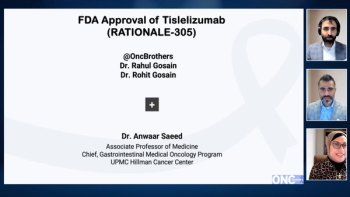
Panelists discuss how RATIONALE-305 represents a significant advancement in first-line treatment for advanced gastric cancer with tislelizumab demonstrating meaningful survival benefits while maintaining a tolerable safety profile that could potentially reshape standard clinical practice.

3 experts are featured in this series.

Panelists discuss how the optimal sequencing between available therapies for advanced gastric cancer remains challenging but should be guided by patient-specific factors, prior treatment response, and molecular characteristics of the tumor.

3 experts are featured in this series.

Panelists discuss how the RATIONALE-305 trial revealed a manageable adverse event profile for tislelizumab plus chemotherapy despite increased rates of neutropenia and anemia compared to placebo plus chemotherapy in advanced gastric cancer patients.

3 experts are featured in this series.

Panelists discuss how RATIONALE-305 trial data shows promising updated overall survival benefits for patients receiving tislelizumab plus chemotherapy compared to placebo plus chemotherapy in advanced gastric or gastroesophageal junction adenocarcinoma.

1 KOL is featured in this series.

A panelist discusses how emerging research in RCC treatment encompasses several promising investigational approaches that could potentially reshape the therapeutic landscape, from novel drug combinations to innovative treatment strategies that may address current gaps in care.

1 expert in this video

An expert discusses how recent analyses from the REFLECT trial in unresectable hepatocellular carcinoma (uHCC) demonstrate that both achieving objective response and greater depth of response correlate with improved survival outcomes. The depth of response serves as a potentially valuable early biomarker for prognosis and treatment decisions, with deeper responses associated with better overall survival among responders.

1 expert in this video

An expert discusses how treatment selection for first-line (1L) tyrosine kinase inhibitor (TKI) therapy in advanced hepatocellular carcinoma (HCC) requires careful evaluation of multiple factors, including liver function (Child-Pugh status), ECOG performance status, tumor burden, and presence of macrovascular invasion or extrahepatic spread. In reviewing individual cases, clinicians assess liver enzyme levels, α-fetoprotein values, radiographic findings, and comorbidities.

1 KOL is featured in this series.

A panelist discusses how managing adverse events associated with TKIs and belzutifan requires a proactive approach encompassing prevention strategies, regular monitoring, dose modifications when needed (particularly for combination regimens), and evidence-based mitigation techniques, while considering the distinct toxicity profiles of each agent and the impact of dose adjustments on treatment efficacy.

1 expert is featured in this series.

A panelist discusses how community practitioners should monitor for immune-related adverse events when using toripalimab for recurrent/metastatic (R/M) nasopharyngeal carcinoma (NPC), establish clear patient communication about toxicities, coordinate multidisciplinary care, consider EBV monitoring, and ensure appropriate patient selection to optimize outcomes.

1 expert is featured in this series.

A panelist discusses A panelist discusses how the integration of immunotherapy with chemotherapy as first-line treatment for recurrent/metastatic (R/M) nasopharyngeal carcinoma (NPC) is transforming the treatment landscape, with data from trials such as JUPITER-02 and DIPPER demonstrating improved progression-free and overall survival outcomes, while patient selection factors including performance status, comorbidities, PD-L1 expression, and EBV status remain critical considerations for optimizing therapeutic benefit in both the metastatic setting and potentially in neoadjuvant/adjuvant approaches.

1 expert is featured in this series.

A panelist discusses how toripalimab has emerged as the preferred treatment regimen for metastatic nasopharyngeal carcinoma (NPC), according to NCCN guidelines, based on improved survival outcomes in clinical trials compared with traditional chemotherapy approaches alone, though individual patient factors including performance status, prior treatments, and specific tumor characteristics must be carefully considered when personalizing the treatment strategy.