APP-led benign hematology consults boost access in community oncology—cut wait times, expand capacity, and show how teams scale safely.

APP-led benign hematology consults boost access in community oncology—cut wait times, expand capacity, and show how teams scale safely.
Discover the final 7.8-year survival data from KEYNOTE-522 and see how adding pembrolizumab to chemotherapy drastically cuts recurrence for early TNBC.
Omar Nadeem, MD, discusses conclusions and next steps based on the CAR-PRISM trial in smoldering myeloma.
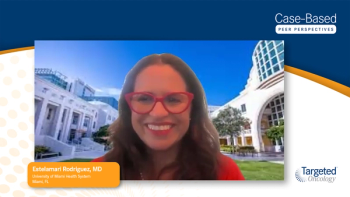
In closing, Dr. Rodriguez emphasizes that for patients who present with brain metastases, first-line treatment selection in EGFR-positive metastatic NSCLC requires weighing CNS efficacy, overall survival, tolerability, and the patient’s priorities, all framed as a shared decision-making conversation.
Dr. Rodriguez describes the current period in EGFR-positive lung cancer as one of active change in the first-line landscape: median overall survival in recent trials has lengthened compared with historical monotherapy data, and durations of CNS disease control are now reported in the range of years. She walks through how sequencing decisions are evolving.
Dr. Rodriguez turns to treatment burden, a central concern for Mr. Smith, who cannot drive because of seizure precautions, lives 45 minutes from clinic, and has a wife who works part-time. She describes the subcutaneous (SC) formulation of amivantamab and how it changes the administration schedule: dosing is approximately 5 minutes versus up to 4 to 5 hours for intravenous (IV) chemotherapy, and the maintenance interval moves from every 2 weeks to every 4 weeks (Q4W). Patients still come weekly during cycle 1, with maintenance visits less frequent thereafter.
Dr. Rodriguez addresses the wife’s concern about managing side effects at home. She frames the main toxicities of amivantamab in two categories. The first is infusion-related reactions (IRRs), which are reduced with the subcutaneous formulation. The second is the combination of cutaneous toxicity (rash, paronychia) and venous thromboembolism (VTE), which requires structured prophylaxis and a proactive plan for at-home management.
Dr. Rodriguez discusses CNS surveillance for Mr. Smith, who has selected subcutaneous (SC) amivantamab plus lazertinib for his 4 brain metastases. His wife asks how often he will need brain MRIs and what to watch for. Dr. Rodriguez contrasts current practice with the pre-targeted-therapy era, when she would have imaged at 6 to 8 weeks primarily to document response and offer radiation if a patient had not responded.
Dr. Rodriguez turns to overall survival (OS), the second question Mr. Smith and his wife raised. For MARIPOSA, median OS has not yet been reached for amivantamab plus lazertinib, with more than half of patients projected to be alive beyond 4 years based on the current data.
Dr. Rodriguez walks through the central nervous system (CNS) efficacy data for the three first-line options. She notes that MARIPOSA was specifically designed for close intracranial monitoring: patients with baseline brain metastases were imaged every 8 weeks, and patients without baseline brain metastases were also followed closely, which she cites as a reason for its National Comprehensive Cancer Network (NCCN) Category 1 recommendation.
Dr. Estelamari Rodriguez introduces the case of Mr. Smith, a 53-year-old man who presents with new-onset headaches and a witnessed seizure. He is a former light smoker (5 pack-year, quit 15 years ago) with type 2 diabetes and no hepatic, renal, or cardiac impairment, no history of venous thromboembolism (VTE), and an Eastern Cooperative Oncology Group (ECOG) performance status of 1.
Ravi Amaravadi, MD, discusses how his team approaches tumor-infiltrating lymphocyte therapy to avoid delays that could keep patients from getting treated.
Mark Agulnik, MD, and Daniel Wang, MD, discuss risk assessment and treatment approaches with systemic therapy for desmoid tumors.
ALPHA3 highlights off-the-shelf allogeneic CAR T in community clinics, reducing leukapheresis hurdles and speeding up delivery.
Phase 2 ALPHA3 shows cema-cel in MRD-positive large B-cell lymphoma has no CRS/ICANS so far, enabling outpatient consolidation with manageable adverse effects.
Interim ALPHA3 data show cema-cel clears ctDNA MRD in high-risk DLBCL after frontline therapy, prompting continued study of consolidation CAR T.
Why frontline CLL care shifts to zanubrutinib: simple daily BTK inhibitor therapy cuts infusions, eases pill burden, adds flexibility.
Six-year data show zanubrutinib remains well tolerated, with rare atrial fibrillation, low bleeding, and no new safety concerns.
Six-year Sequoia data show zanubrutinib in frontline CLL extends PFS far beyond bendamustine‑rituximab, delaying next treatment.
Six-year Sequoia data show zanubrutinib in frontline CLL extends PFS far beyond bendamustine‑rituximab, delaying next treatment.
For high-risk CLL, experts favor continuous BTK inhibitors and weigh venetoclax visit demands to match frontline therapy to lifestyle.
Experts explain racial gaps in molecular testing and how limited trial diversity affects treating HER2-mutant lung cancer in Black patients.
Compare oral vs IV HER2-targeted lung cancer therapies, including zangertinib and antibody–drug conjugates, with response rates and access considerations.
Explore how taletrectinib's CNS penetration may delay brain metastases and reduce the need for radiation in non–small cell lung cancer patients with ROS1.
Compare infusion schedules and travel burden as new subcutaneous therapy shifts to quick monthly doses versus chemo every three weeks.
In this final episode, Dr. Doroshow examines how HER2-mutant non-small cell lung cancer treatment will evolve over the next two years, then synthesizes key takeaways from Sandra's case.
This episode addresses how second-line HER2-directed therapy selection influences subsequent treatment options in advanced HER2-mutant non-small cell lung cancer.
Weigh amivantamab–lazertinib skin rash options against chemo neutropenic fever and fatigue, with practical supportive-care tips.
Early study data show community oncology matches or beats hospital cancer outcomes at lower cost, boosting local access, better experience, and payment reform calls.
Heather Stefanski, MD, PhD, discusses the significance of reducing the dose of post-transplant cyclophosphamide in the OPTIMIZE trial.