Heather J. Landau, MD, discusses the most exciting outcomes observed in a trial of BCMA-targeted NXC-201 for light chain amyloidosis.

Heather J. Landau, MD, discusses the most exciting outcomes observed in a trial of BCMA-targeted NXC-201 for light chain amyloidosis.

Doris K. Hansen, MD, discusses outcomes from a large retrospective study of patients treated with ciltacabtagene autoleucel for relapsed/refractory multiple myeloma.
Lung cancer increasingly hits never-smoking women; learn how biomarker testing, earlier screening, and stronger self-advocacy speed diagnosis and unlock better treatments.

Two new oncologists share raw truths on fellowship loneliness, fear of autonomy, and building networks that make the leap to faculty survivable.

The panel discusses the full multidisciplinary team required to optimize outcomes for patients with ROS1-positive advanced NSCLC: neuro-oncology for brain metastasis management, radiation oncology for CNS and bone disease, palliative care and symptom management specialists from diagnosis, physical therapy and nutrition, social work, and mental health services.
The panel addresses patients who received crizotinib or entrectinib in first line rather than lorlatinib, and who are now progressing.
The panel reinforces that oligo-progression management in ROS1-positive NSCLC requires careful distinction from strategies used in EGFR-mutated NSCLC.
For the patient with a G2032R resistance mutation and intracranial progression, the panel unanimously favors lorlatinib-based therapy in second line based on its known activity against solvent-front mutations and documented CNS penetrance, with median duration of response of approximately 7 to 8 months in this setting.
The second clinical case presents a patient with ROS1 fusion-positive advanced NSCLC who achieved partial response on frontline lorlatinib, maintained for 18 months, before symptomatic and radiographic progression: increasing primary tumor size, new contralateral pulmonary nodules, and brain MRI showing 3 new small intracranial lesions.
Given the patient's osseous disease, the panel discusses bone-directed therapy integration.
All panelists select lorlatinib at 600 mg for this patient based on response rates, duration of disease control, favorable tolerability, and its design intent to achieve superior CNS penetration compared to earlier-generation ROS1 inhibitors, which is particularly relevant given the patient's age, symptomatic disease burden, and risk of future CNS progression.
The first clinical case presents a 58-year-old female never-smoker with persistent cough, mild dyspnea, and new right-sided pleural effusion.
The panel addresses scenarios where patients arrive on treatments other than the panel's preferred agent.
Beyond efficacy, the panel identifies the key factors influencing agent selection: brain metastasis activity given the high prevalence of CNS involvement in younger ROS1-positive patients; toxicity profiles (earlier agents cause significant dizziness, taste changes, and neuropathic pain that are poorly tolerated chronically); frequency of clinic visits; and insurance access.

Oral golcadomide with rituximab delivers high responses and manageable safety, enabling outpatient care for relapsed follicular lymphoma.
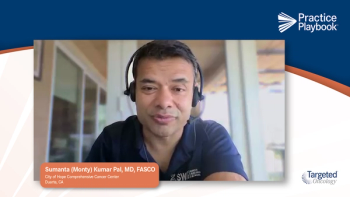
Dr. Monty Pal compares the available immunotherapy plus tyrosine kinase inhibitor (IO/TKI) combination regimens for the first-line treatment of advanced renal cell carcinoma (RCC) and explains the clinical rationale behind his preferred treatment approach.
Dr. Monty Pal reviews how current clinical guidelines support both immunotherapy plus tyrosine kinase inhibitor (IO/TKI) combinations and dual immunotherapy (IO/IO) as frontline treatment options for advanced renal cell carcinoma (RCC).
Golcadomide plus rituximab shows deep, durable responses in relapsed follicular lymphoma, with manageable neutropenia and limited added toxicity.
Adam Cuker, MD, MS, discusses how the goals of treatment for immune thrombocytopenia have developed beyond managing platelet count.
Peter Voorhees, MD, discusses the cost-benefit question of adding pomalidomide to daratumumab and talquetamab in early relapsed multiple myeloma.
In an interview, Peter Voorhees, MD, discusses why talquetamab is typically sequenced after BCMA-targeting agents and the unique situations where it might be used first.
Misako Nagasaka, MD, PhD, describes how it is a “great time to be a thoracic oncologist” with the constantly expanding armamentarium in the field. She specifically discusses the available treatment options in frontline EGFR mutation–positive advanced non–small cell lung cancer and what particular clinical and lifestyle benefits are provided by the treatment regimen of subcutaneous amivantamab plus lazertinib.
Misako Nagasaka, MD, PhD, discusses practical considerations for oncologists implementing subcutaneous (SC) vs intravenous (IV) amivantamab plus lazertinib in the frontline setting for patients with EGFR-mutated advanced or metastatic non–small cell lung cancer. Nagasaka recommends the SC over the IV regimen in the frontline setting, particularly when focusing on convenience and patients’ quality of life.
Misako Nagasaka, MD, PhD, explains the use of prophylactic anticoagulation for preventing venous thromboembolism (VTE) when administering amivantamab plus lazertinib in patients with EGFR-mutated advanced non–small cell lung cancer. The prophylactic anticoagulation is particularly recommended for the first 4 months of treatment, when the risk of VTE is highest.
Misako Nagasaka, MD, PhD, discusses optimizing patient management when administering frontline SC amivantamab plus lazertinib in patients with EGFR-mutated advanced non–small cell lung cancer. She describes how the majority of adverse events (AEs) with the SC regimen in the PALOMA-2 trial occurred during first 4 months of treatment. According to Nagasaka, this highlights the importance of early patient counseling regarding expectations and reporting of AEs when starting the SC regimen.
Misako Nagasaka, MD, PhD, describes the tolerability results with subcutaneous (SC) amivantamab plus lazertinib in patients with treatment-naïve, EGFR-mutated advanced non–small cell lung cancer from the PALOMA-2 trial. She explains that the data thus far have shown comparable discontinuation rates related to adverse events for the SC regimen compared with what has been observed with intravenous amivantamab regimens in prior studies.
Misako Nagasaka, MD, PhD, discusses the overall response rate and duration of response with subcutaneous (SC) amivantamab plus lazertinib in patients with treatment-naïve, EGFR-mutated advanced non–small cell lung cancer, as reported from the PALOMA-2 trial. She explains the significance of the durability demonstrated by the SC regimen in the frontline setting for EGFR-mutated advanced NSCLC.
INSIGHT tests if NSCLC super-responders with pathologic complete response can skip adjuvant durvalumab, reducing toxicity without sacrificing survival.
Dr. Monty Pal discusses the historical role of the International Metastatic Renal Cell Database Consortium (IMDC) risk criteria in guiding treatment decisions for advanced renal cell carcinoma (RCC) and explains why its influence has evolved in the current therapeutic landscape.
Dr. Monty Pal introduces the program by outlining the evolving treatment landscape for advanced renal cell carcinoma (RCC) and emphasizing the importance of translating clinical trial evidence and guideline recommendations into individualized patient care.